
How Does Agentic AI Differ From Traditional Automation? Understanding the Key Distinctions
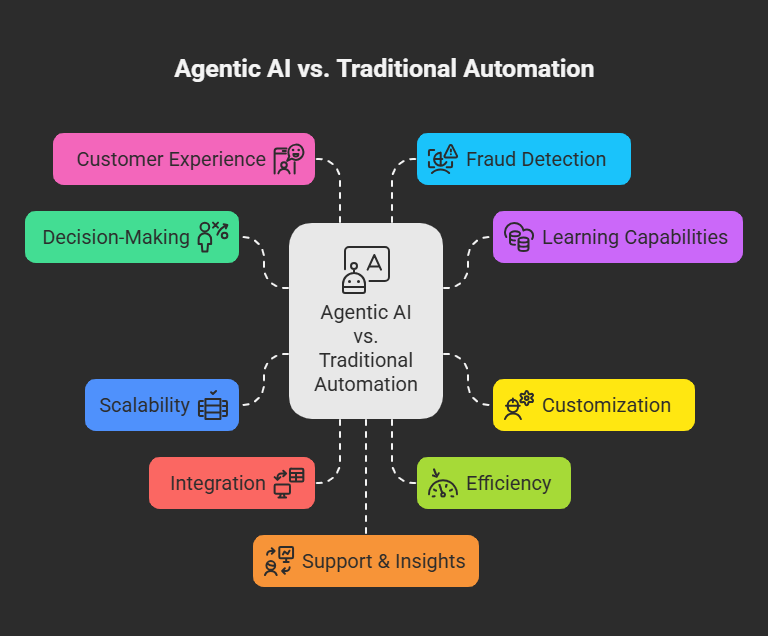
Understanding Agentic AI vs. Traditional Automation
Estimated Reading Time: 6 minutes
Key Takeaways
-
Traditional automation follows predefined rules and is ideal for repetitive, predictable tasks.
-
Agentic AI is goal-oriented, capable of autonomous decision-making, learning, and adapting to new situations.
-
The core distinction lies in autonomy and the ability to break down complex goals into actionable steps without explicit programming for each step.
-
Agentic AI systems can reason, plan, and self-correct, making them suitable for dynamic and uncertain environments.
-
While automation optimizes efficiency for known processes, agentic AI aims to solve novel problems and achieve higher-level objectives.
Table of Contents
- Introduction: A New Era of Intelligent Systems
- What is Traditional Automation?
- Unveiling Agentic AI
- The Fundamental Differences
- Use Cases: Where Each Shines
- The Future of Work and Technology
- Frequently Asked Questions (FAQ)
Introduction: A New Era of Intelligent Systems
In the rapidly evolving landscape of artificial intelligence, terms like “automation” and “agentic AI” are frequently discussed. While both aim to streamline processes and enhance efficiency, they represent fundamentally different approaches to task execution and intelligence. Understanding these distinctions is crucial for harnessing their respective powers effectively. This post will delve into how agentic AI dramatically differs from the traditional automation we’ve grown accustomed to, highlighting their unique capabilities and applications.
What is Traditional Automation?
Traditional automation, often seen in Robotic Process Automation (RPA) or manufacturing robots, operates on a simple principle: follow predefined rules. It excels at performing repetitive, high-volume tasks that have clear, predictable steps. Think of factory assembly lines, automated data entry, or scheduled email campaigns. These systems are programmed with explicit instructions for every possible scenario they might encounter.
“Traditional automation is about optimizing known processes. It’s a powerful tool for efficiency when the path is clear and unchanging.”
Key characteristics include:
-
Rules-based: Every action is triggered by a specific, coded rule.
-
Deterministic: Given the same input, the output will always be the same.
-
Limited adaptability: Requires human intervention to update rules for new situations or errors.
-
Efficiency-driven: Focuses on speeding up and standardizing existing workflows.
Unveiling Agentic AI
Agentic AI, by contrast, represents a significant leap forward. At its core, an agentic AI system is designed to be goal-oriented and autonomous. Instead of being given a step-by-step instruction manual, it’s given an objective. The AI then plans, executes, and monitors its own actions to achieve that objective, adapting its strategy as needed.
Imagine an AI tasked with “researching the latest trends in sustainable energy.” A traditional automation system would simply search predefined databases for keywords and return results. An agentic AI, however, might:
-
Break down the goal into sub-tasks: “identify key sources,” “extract relevant data,” “synthesize findings,” “format into a report.”
-
Choose appropriate tools: web crawlers, natural language processing models, data analysis tools.
-
Execute actions: perform searches, read articles, summarize content, cross-reference information.
-
Evaluate progress: if initial searches yield poor results, it might refine its search strategy or explore new databases.
-
Self-correct: if a generated summary is inaccurate, it might revisit the source material.
This iterative, self-directed process is what defines agentic behavior.
The Fundamental Differences
The distinction between agentic AI and traditional automation can be understood through several key pillars:
Autonomy and Decision-Making
-
Traditional Automation: Minimal to no autonomy. Decisions are hard-coded; any deviation requires human reprogramming.
-
Agentic AI: High degree of autonomy. Can make independent decisions, plan its own actions, and sequence tasks to achieve a goal. It operates with a sense of “understanding” the objective.
Learning and Adaptability
-
Traditional Automation: Does not learn or adapt on its own. It’s brittle to changes in environment or input data.
-
Agentic AI: Can learn from interactions, feedback, and new information. It can adapt its strategies and improve performance over time, even in dynamic or uncertain environments.
Goal Orientation vs. Rule-Following
-
Traditional Automation: Task-centric. Executes a precise set of rules for a specific task.
-
Agentic AI: Goal-centric. Given a high-level objective, it devises the necessary tasks and steps to reach it, often dynamically.
Problem-Solving Approach
-
Traditional Automation: Solves clearly defined problems with known solutions by following a script.
-
Agentic AI: Can tackle complex, ill-defined problems by breaking them down, exploring possibilities, and generating novel solutions. It engages in a form of reasoning.
Use Cases: Where Each Shines
Understanding where to deploy each technology is paramount:
-
Traditional Automation is best for:
-
Repetitive data entry and processing.
-
Scheduled report generation.
-
High-volume, low-variability manufacturing.
-
Routine customer service inquiries with predefined scripts.
-
-
Agentic AI is best for:
-
Complex research and content generation.
-
Autonomous code generation and debugging.
-
Dynamic strategic planning and execution in business operations.
-
Personalized learning environments that adapt to individual student needs.
-
Advanced robotics navigating unpredictable environments.
-
The Future of Work and Technology
The rise of agentic AI doesn’t spell the end for traditional automation. Instead, it expands the horizons of what’s possible. Traditional automation will continue to be vital for optimizing foundational, predictable processes. Agentic AI, however, will empower organizations to tackle challenges that require more cognitive flexibility, planning, and adaptive problem-solving.
Ultimately, these two forms of intelligence are complementary. Traditional automation can feed structured data to agentic systems, while agentic AI can design more intelligent automated workflows. The synergy between them promises a future of unprecedented efficiency and innovation.
Frequently Asked Questions (FAQ)
- What is the core difference between agentic AI and traditional automation?
The core difference lies in their approach to tasks. Traditional automation follows predefined, explicit rules for repetitive tasks, lacking autonomy and adaptability. Agentic AI, on the other hand, is goal-oriented, planning and executing its own steps autonomously to achieve an objective, capable of learning and adapting to dynamic situations.
- Can agentic AI replace human judgment?
While agentic AI can simulate reasoning and make complex decisions, it does not possess human-like consciousness, intuition, or ethical judgment. It augments human capabilities by handling intricate problem-solving and task execution, freeing humans to focus on higher-level strategic thinking, creativity, and ethical considerations. Human oversight and guidance remain crucial.
- Is agentic AI more expensive to implement than traditional automation?
Generally, implementing agentic AI can be more complex and therefore potentially more expensive initially due to the need for advanced AI models, robust data infrastructure, and specialized expertise for development and deployment. Traditional automation, particularly RPA, can often be implemented more quickly and at a lower cost for well-defined, existing processes. However, the long-term ROI for agentic AI can be significantly higher for tasks requiring adaptability and problem-solving.